


For the first time, our past does not disappear. It remains visible, photographed and shared, accompanying us as we become someone new.
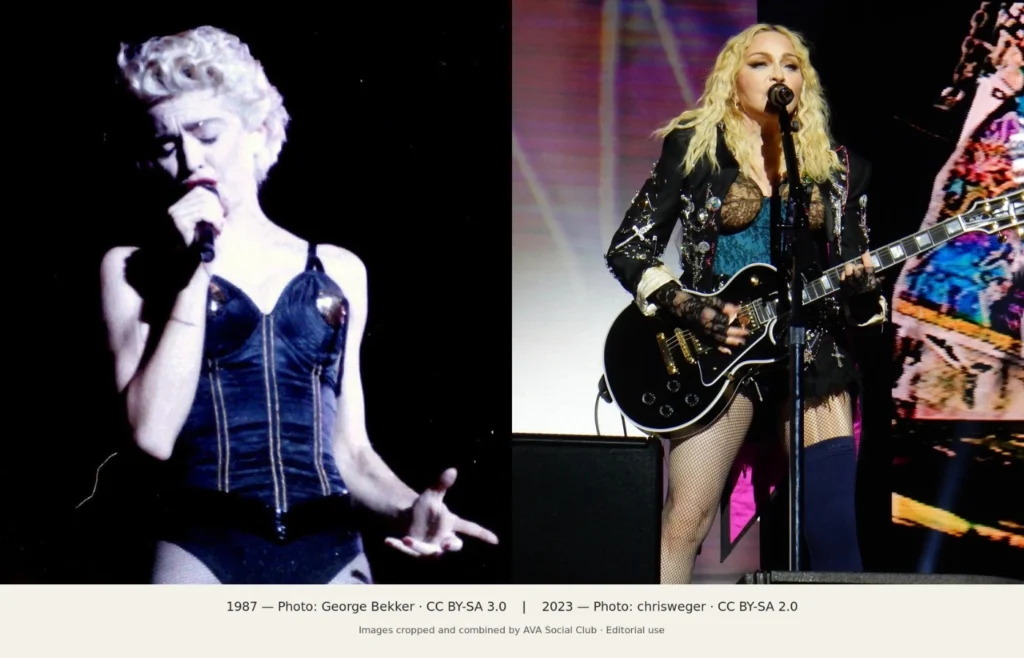
Madonna is sixty-seven and releasing a new album.
The news could end there. An artist puts out new work, returns to the stage and continues to do what she has always done: change, provoke and divide opinion.
And yet, whenever Madonna appears, the conversation seems to focus above all on her age.
Her face. Her body. Her clothes. What she should or should not reveal. How a sixty-seven-year-old woman is supposed to behave.
As if the issue were not what she is doing today, but how far she has moved from the image we still hold of her.
The Madonna of 1984. The Madonna of the 1990s. The Madonna of Ray of Light. The Madonna of Confessions on a Dance Floor.
They all continue to exist at the same time.
A recent article published by Il Sole 24 Ore raised an interesting point: Madonna is one of the first major global celebrities to grow older in front of a permanent digital archive of her own youth.
But, in different ways and on a different scale, this now applies to all of us.
Our different ages no longer follow one another
There was a time when photographs were kept in albums we opened only occasionally.
The past lived in our memories, in the stories we told and in a few images stored away in a drawer. To find the person we had been twenty or thirty years earlier, we had to go looking for her.
Today, that person is always in front of us.
Facebook brings back a photograph from ten years ago. Google preserves images, articles and traces of our lives. Instagram places moments separated by decades alongside one another.
The past no longer remains behind us. It coexists with the present.
And so, almost without realising it, we begin to compare who we are today not only with other people our age, but with earlier versions of ourselves.
Today’s face with yesterday’s.
The body we have now with the one we had at forty.
The energy we feel today with the energy we remember having.
It is a constant and often unfair comparison.
Because growing older does not mean remaining faithful to our youngest image.
It means becoming someone new.
We are not faded versions of who we used to be
Contemporary culture encourages us to preserve everything: photographs, experiences, bodies, achievements and identities.
It asks us to change, but preferably without showing the signs of change.
Especially women.
We may continue to work, create, travel, desire and build. But we are expected to do so without unsettling the collective imagination too much. Without appearing “too young” and without looking “too old”. Without going too far. Without stepping outside the role our age is supposed to assign us.
It is an impossible standard.
Perhaps the point is not to decide whether Madonna is ageing well or badly..
The point is to ask why we expect a woman, in order to be accepted as she grows older, to become more discreet, more reassuring and less visible.
And why we continue to judge her present through the lens of who she used to be.
The right to no longer resemble who we were
At a certain point in life, our priorities change.
The relationships we choose change. The places where we want to spend our time change. The way we use that time changes too.
So does what we are no longer willing to accept.
We do not always recognise ourselves in our chronological age. Not because we want to turn back time.
We simply do not recognise ourselves in the idea of life that number is supposed to impose upon us.
We can be sixty or seventy and still feel fully in motion. We can start a new project, meet new people, change careers, travel or build a different everyday life.
We can also decide that we no longer want to resemble the person we once were.
That is not inconsistency.
It is evolution.
A new season, not a replica of the last
Perhaps we should begin to see this stage of life not as an attempt to preserve youth, but as a season with an identity of its own.
Not an “after”.
Not a diminished version of the life that came before.
A next chapter.
One shaped by greater awareness, more freedom of choice and less willingness to accept what no longer represents us.
Madonna will probably continue to provoke, reinvent her image and divide opinion. It is what she has always done.
But the question she leaves open concerns all of us:
How much space are we willing to give the person we are becoming, without constantly forcing her to resemble the person we used to be?
The images from our past will remain.
Fortunately, we will continue to change.