


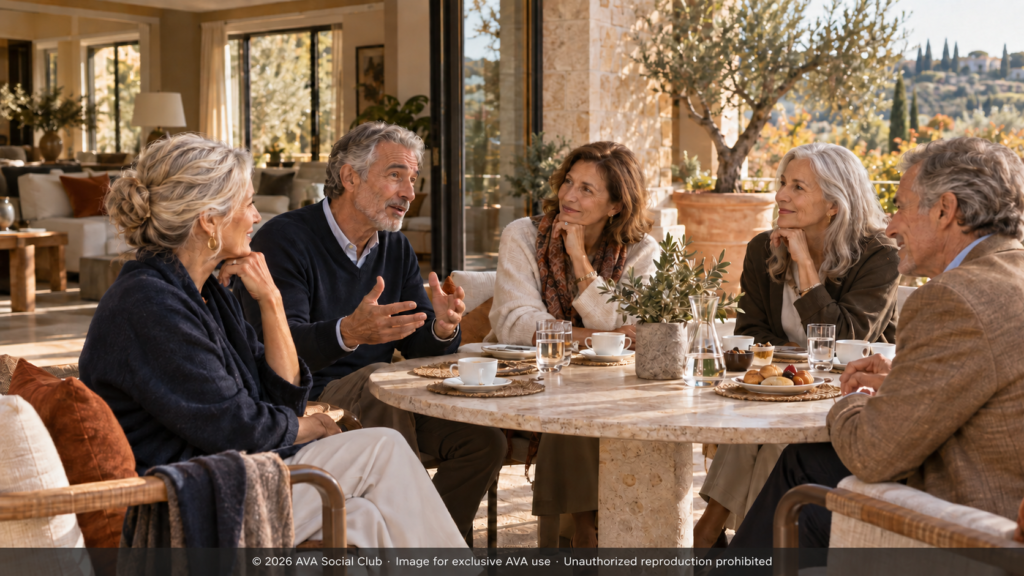

Living longer invites us to look further ahead: what experiences do we want for ourselves, and where might we find a sense of belonging in the years to come?
Making friends after 55 can reflect many different wishes: sharing an interest, finding travel companions or broadening our social lives. These possibilities matter even when we have a stable relationship, close family ties and full schedules.
When we think about the future, we imagine what we would like to do and whom we would like to share it with. A trip we have postponed, a passion we want to explore, a project we might finally have time for. Often, we carry our present relationships and routines into that picture. This is a natural starting point, but it leaves a question open: how might our lives, and what we want from our relationships, change over time?
Sometimes, an everyday situation brings this into focus: an exhibition that catches our attention, a free Sunday, a wish for a different kind of conversation. We can have meaningful relationships and still discover that a new interest finds little response within our usual circle.
Discussions about longevity often focus on health and independence. A longer life also invites us to consider how we want to spend our time: what we would like to keep learning, which experiences we want to choose and where we might feel we belong. Our social lives deserve a place in that vision of the future.
How Relationships Change in Adulthood
A stable partnership, a supportive family and longstanding friendships can give us a deep sense of security. Precisely because these relationships sustain us, we may begin to take our present circumstances for granted. Meeting new people can seem like something other people need.
Then time passes, and life happens. A relationship may end, someone important to us may die, or family routines may change. Sometimes, we find ourselves alone in circumstances we had never imagined for ourselves. Going out, having a conversation or finding someone to share an experience with takes on a different urgency. What once seemed unnecessary becomes a real need.
We can take an interest in our future while we are still happy in the present. Appreciating the people we love and being open to new connections can go together. Curiosity allows us to explore a setting and meet people without the pressure of having to fill an immediate gap.
Our reasons for seeking company also change over the years. At times, we want travel companions; at others, someone who shares a passion or people we can see more regularly. Leaving room for these possibilities allows our relationships to evolve alongside us.
Where to Meet New People and Feel at Ease
A cultural activity, an interest group or an experience shared in a small group can create opportunities to meet people. To understand whether a setting suits us, it helps to notice how it feels to arrive. Are we welcomed? Is it easy to take part on our own? Will there be opportunities to see the same people again?
Being part of a thoughtfully organised social setting can have value even when we feel no immediate need for it. We can get to know its character and discover familiar points of connection. When we feel like taking part, we already have somewhere to begin.
Starting from scratch takes energy: deciding where to go, whom we might meet and whether an experience will match our expectations. Knowing where to find opportunities that reflect our interests can make the search easier and reduce the uncertainty of taking the first step.
The care behind a social setting shows in the attention given to people, the clarity of its participation criteria and the way newcomers are welcomed. An approach to membership that considers shared values and a willingness to participate can help build trust. Personal affinities then need shared experience to emerge.
Part of the value of belonging lies in having somewhere to return to, at our own pace and as our needs develop. That possibility can be reassuring even now. That possibility can be reassuring even now.
Building New Friendships Through Familiarity
A place becomes familiar through simple moments: recognising a face, picking up a conversation or remembering something someone told us. Meeting again allows us to move beyond first impressions and discover what we would enjoy sharing.
Jeffrey Hall’s research on friendship formation found an association between time spent together and greater closeness, while also examining shared activities and everyday conversation. Spending time together gives a relationship room to grow, without guaranteeing its outcome.
Fonte: Journal of Social and Personal Relationships
Supporting this continuity takes care: opportunities to meet again, ease of participation and the freedom to become comfortable gradually. People who are more reserved should also be able to find their own way of taking part.
An enjoyable experience can then lead to another. A conversation sparks a suggestion; a shared interest becomes a regular activity. Over time, some relationships develop a life of their own and become part of our everyday lives.
Longevity and Social Life: Making Room for Your Future
After 55, our wishes and plans deserve to be considered for what they are: expressions of who we are and who we are becoming. Portrayals of adult life that focus mainly on limitations and established roles leave many possibilities out of the picture.
Each of us can choose our own pace. We do not need to fill every space in our diaries or prove how active we are. What matters is having room to follow our curiosity, accept an invitation or spend time with people who help us discover something about ourselves that we have yet to explore.
Thinking about longevity means paying attention to this part of our future too. The relationships we nurture today can accompany us through tomorrow’s changes, bringing interests, perspectives and possibilities we have not yet imagined.
What experiences would we like to have in the years ahead? And what can we do today to find a setting where we feel at ease, knowing we have somewhere to turn when we need it?