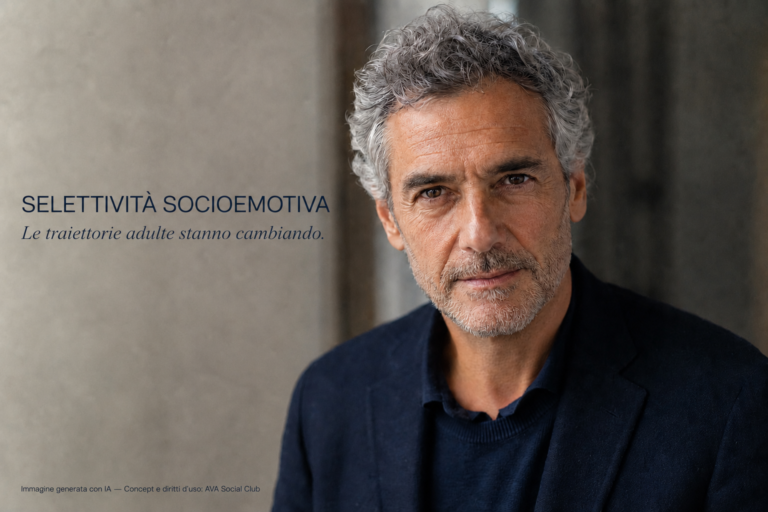




Where does social connection after 50 take shape today?
We may want to meet new people.
We may be curious, open, even determined to start moving again.
But desire alone does not create an encounter.
Relationships do not depend solely on our openness. They also depend on the existence of spaces where meeting, recognising one another and returning feel natural.
And this is precisely what seems to have become more difficult.
Our lives have grown longer. Family and professional paths have changed. We are more likely to live alone, work differently and move through more transitions than previous generations.
Yet the spaces for adult social connection do not seem to have evolved at the same pace.
Beyond home and work: what are third places?
In the late 1980s, American sociologist Ray Oldenburg introduced the concept of third places.
Home represents our private sphere.
Work represents our professional one.
Third places are informal spaces where people can meet outside family and professional obligations: a café, a library, a park, a club or a neighbourhood venue.
Their purpose is not simply to offer something to do.
It is to allow people to spend time in one another’s company.
We can enter a venue, order something and leave without speaking to anyone. In a genuinely social space, by contrast, repeated visits gradually make faces familiar, reduce distance and make conversation easier.
Relationships very often do not begin with an extraordinary moment.
They begin with the possibility of meeting again.
Being close does not mean belonging
We can sit in a crowded restaurant, attend a busy event or spend a week in a wonderful place without building a single relationship.
Physical proximity creates presence.
Not necessarily connection.
For a space to genuinely support social connection, it needs continuity, an atmosphere that makes interaction easy, a scale that does not intimidate and a credible reason to return.
Research on third places shows how informal settings in everyday life can support participation, belonging and wellbeing among adults.
Parks, libraries, cafés and local activities can become part of a community’s social infrastructure. But their physical existence alone is not enough.
What matters is how they are experienced and whether they allow interactions to happen repeatedly.
A space becomes social through what it makes possible.
When efficiency removes opportunities to meet
A growing share of everyday life is designed around efficiency.
We can work from home, shop without entering a store, order dinner without sitting in a restaurant and communicate without sharing the same environment.
We have removed many steps that once seemed unnecessary.
Yet those very steps created small encounters: a conversation, a familiar face, a presence that became recognisable over time.
Not all of these interactions developed into friendships.
They did not need to.
They still formed a social fabric: lighter ties, but ties capable of making us feel part of an environment rather than merely individuals passing through.
The World Health Organization’s Commission on Social Connection calls for social connection to be recognised as an essential component of health and quality of life, alongside physical and mental wellbeing.
This changes the perspective.
Building relationships cannot be entrusted solely to individual goodwill. It also requires favourable social, cultural and environmental conditions.
Why social connection changes after 50
In this new stage of adulthood, the issue becomes even more evident.
Work may lose its central role or take different forms.
Children progressively build independent lives.
Some relationships change; others end. Moving, separation and new routines can reshape social networks built over decades.
The need for connection does not disappear.
What may disappear are the environments where that need once found a natural response.
Greater selectivity also comes into play.
Over time, we become less willing to invest energy in situations where we do not recognise ourselves. We are not necessarily looking for more opportunities. We are looking for opportunities that give value back to our time.
This is where the model of third places meets a new question.
Not only:
Where can I go?
But:
Where can I naturally feel at ease?
From accidental places to intentional settings
An intentional setting does not promise that every encounter will become a relationship.
It can, however, reduce randomness and thoughtfully design the initial conditions.
It can choose a scale that allows people to talk to one another.
It can prevent someone arriving alone from remaining at the edge of already established groups.
It can create continuity from one experience to the next.
It can ensure that people share not only a table or a destination, but at least a genuine openness to meeting others.
This is the difference between organising an event and building a relational ecosystem.
An event ends.
An ecosystem, when it is well designed, gives people a reason to return.
Social connection cannot be left entirely to chance
For a long time, we assumed that relationships should simply happen.
At school.
At work.
Through family.
Through lifelong friends.
When these systems change, however, relying entirely on chance progressively reduces the likelihood of meeting someone.
Designing social connection does not mean making it artificial.
It means recognising that even the most spontaneous relationships need a place, time, continuity and people who are willing to be there.
Perhaps the point is not to keep finding something new to do.
It is knowing that there is a place you can return to.
Sources
- World Health Organization, From loneliness to social connection: charting a path to healthier societies, 2025
- Sugiyama et al., Third Places for Older Adults’ Social Engagement: A Scoping Review, The Gerontologist
- Finlay et al., Closure of “Third Places”? Exploring Potential Consequences for Collective Health and Wellbeing, Health & Place
- Ray Oldenburg, The Great Good Place